3D Isometric Three-dimensional City: A Practical Guide to Urban Design Assets
In the rapidly evolving landscape of digital design and visual communication, few styles have maintained their relevance as effectively as the 3D Isometric Three-dimensional City. This specific aesthetic, characterized by its unique perspective where all three dimensions are represented equally without vanishing points, has transcended its origins in pixel art and retro gaming to become a cornerstone of modern infographics, game development, and architectural visualization. For professionals ranging from data journalists to mobile app designers, understanding the nuances of this style is not merely about following a trend; it is about mastering a powerful tool for conveying complex spatial information with clarity and engagement.
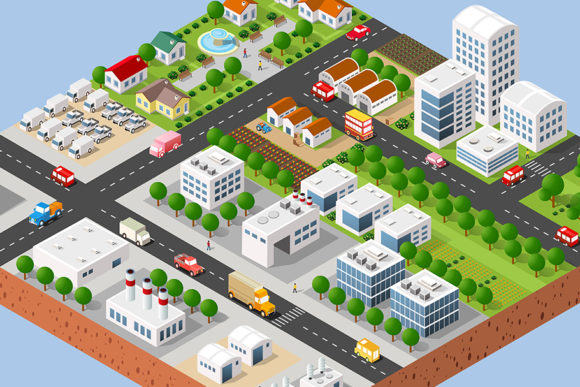
The core appeal of a 3D isometric three-dimensional city with houses, skyscrapers, buildings and streets with traffic lies in its ability to present a comprehensive overview of urban infrastructure without the distortion inherent in traditional one-point or two-point perspective. When viewed from a top-down angle that maintains equal scaling across axes, the viewer can appreciate the density, layout, and interconnectivity of a metropolis simultaneously. This makes it an invaluable resource for the creation and design of projects that require a clear representation of scale, zoning, and flow.
Defining the Visual Language
To utilize this asset class effectively, one must first understand what distinguishes a high-quality 3D Isometric Three-dimensional City from a generic 3D render. The defining characteristic is the projection method. Unlike standard 3D modeling which mimics human vision with depth cues that converge at a horizon line, isometric projection preserves parallel lines. In a city scene, this means that vertical lines remain vertical, while horizontal lines recede at exactly 30-degree angles. This geometric consistency allows for precise measurement and alignment within the digital space.
When evaluating assets labeled as a 3d isometric three-dimensional city with houses, skyscrapers, buildings and streets with traffic, attention must be paid to the coherence of the grid. High-quality sets feature modular components that snap together seamlessly. A residential block should align perfectly with a commercial district, and the road network must facilitate logical movement. The inclusion of traffic elements—vehicles, pedestrians, and transit systems—is not just decorative; it provides a sense of life and activity that static architecture lacks. These dynamic elements help communicate the function of different zones within the urban plan.
Strategic Applications in Professional Workflows
The utility of this visual style extends far beyond simple illustration. In the realm of marketing and advertising, a well-crafted 3D Isometric Three-dimensional City serves as an excellent vehicle for explaining business models, logistics networks, or expansion strategies. Marketers often use these visuals to demonstrate how a service connects various nodes in a supply chain or how a platform integrates into a user's daily environment. The "bird's-eye view" nature of the isometric perspective allows stakeholders to grasp the entire ecosystem at a glance, reducing cognitive load compared to navigating through a series of flat maps or detailed floor plans.
For educators and content creators, the pedagogical value is equally significant. Explaining concepts like population density, public transportation efficiency, or sustainable urban planning becomes more intuitive when visualized through a stylized city. The clean lines and distinct separation of building types (houses versus skyscrapers) allow viewers to focus on the structural relationships rather than getting lost in photorealistic textures. This abstraction is particularly effective when the goal is to convey data or process flow rather than emotional atmosphere.
In the field of game development and interactive media, the demand for consistent isometric assets remains robust. Indie developers, in particular, rely on pre-made or custom-designed 3d isometric three-dimensional city with houses, skyscrapers, buildings and buildings and streets with traffic to populate their worlds quickly without sacrificing visual fidelity. The modularity of these assets allows for rapid iteration. A designer can swap out a park for a shopping center or alter the traffic density to test gameplay mechanics related to congestion or resource management.
Evaluating Quality and Usability
Not all isometric assets are created equal. When sourcing or creating a 3D Isometric Three-dimensional City, several technical factors determine its long-term value. Lighting consistency is paramount. Because the style relies on geometry rather than realistic shadows to define form, the light source must be uniform across all objects. If the sun hits a skyscraper differently than a nearby house, the illusion of a cohesive world breaks down immediately. Professionals should look for assets that offer multiple lighting variations or are designed with a global illumination approach that respects the isometric constraints.
Texture resolution and material definition also play critical roles. While the style is often associated with low-poly aesthetics, modern interpretations frequently incorporate high-fidelity textures to create a rich visual experience. However, the texture mapping must be carefully aligned with the isometric grid. Misaligned textures can cause visual jittering or make the scene appear "floating." Furthermore, the level of detail in the streets with traffic component requires balance. Too much detail can clutter the screen, especially when used in small formats like mobile interfaces, while too little can make the scene feel barren and lifeless.
Flexibility is another key metric. The best assets provide layers or separate files for different elements. Being able to isolate the traffic layer from the building layer allows for dynamic adjustments. For instance, a designer might want to show a city during rush hour with heavy traffic, then switch to a quiet evening scene by simply toggling visibility. This capability significantly enhances the workflow for freelancers and agencies who need to deliver varied outputs from a single asset library.
Limitations and Considerations
Despite its strengths, the 3D Isometric Three-dimensional City is not a universal solution. One primary limitation is the lack of true depth perception. Because there is no perspective convergence, judging the distance between two objects can sometimes be challenging for users unfamiliar with the format. This can be problematic for applications requiring precise spatial navigation, such as virtual reality tours or architectural walkthroughs where realism is the priority.
Additionally, the stylistic choice can clash with other design elements if not integrated thoughtfully. Mixing a highly stylized isometric city with photorealistic character portraits or organic landscapes can result in a disjointed user experience. It is essential to maintain a consistent artistic direction throughout a project. Brands aiming for a sleek, futuristic, or minimalist image may find the dense, blocky nature of a traditional isometric city too busy or retro-focused.
Performance considerations also apply, particularly for web-based implementations. Rendering a full 3d isometric three-dimensional city with houses, skyscrapers, buildings and streets with traffic in real-time can be computationally expensive. Developers must optimize polygon counts and texture sizes to ensure smooth performance across devices. While static images pose no issue, interactive versions require careful coding to manage the rendering load without compromising the visual quality.
Who Benefits Most?
This visual approach is particularly suited for professionals who need to communicate complexity through simplicity. Urban planners presenting proposals to municipal councils will find the clarity of isometric views invaluable for demonstrating zoning changes. Tech entrepreneurs pitching a smart city initiative can use these assets to visualize sensor placement and data flow across a physical landscape. Content marketers targeting B2B audiences often leverage these graphics to simplify intricate service offerings.
Freelancers and solo creators benefit from the availability of modular assets, which reduce production time and costs. Instead of modeling every building from scratch, they can assemble a convincing cityscape using pre-built components, allowing them to focus on the narrative and messaging of their project. Similarly, educators can create engaging lesson materials that capture student interest without the steep learning curve associated with professional 3D modeling software.
Conclusion
The 3D Isometric Three-dimensional City represents a intersection of technical precision and artistic expression. Its enduring popularity stems from its unique ability to organize visual chaos into a structured, readable format. Whether used for data visualization, game environments, or marketing collateral, the style offers a versatile framework for storytelling. By understanding its characteristics, limitations, and optimal use cases, designers and strategists can leverage this medium to create impactful, functional, and aesthetically pleasing digital experiences. As digital spaces continue to evolve, the principles of isometric design will likely remain a fundamental part of the visual toolkit for those who wish to map the future of our urban environments.