3D Christmas Tree: Creating Stunning Holiday Decor Without the Headaches
The holiday season is a time for creativity, but it can also be a minefield of wasted money and frustration if you choose the wrong digital assets. A 3D Christmas Tree design is more than just a festive image; it is a versatile template that serves as the foundation for everything from custom ornaments and wall art to professional marketing materials and boutique product lines. However, many creators jump into this project without understanding the technical nuances of file formats, leading to poor cut quality, blurry prints, or software incompatibility.
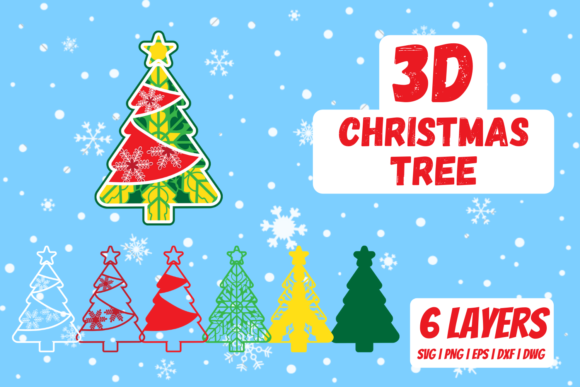
If you are looking to bring a three-dimensional holiday spirit to life, the difference between a successful project and a failed one often comes down to the specific files you download. You need a comprehensive package that offers flexibility across different cutting machines and design software. The ideal solution includes a zipped folder containing SVG, DXF, PNG, DWG, and EPS formats. This variety ensures that whether you are a hobbyist with a Cricut machine or a small business owner using industrial plotters, your 3D Christmas Tree design will work exactly as intended.
Navigating Software Compatibility: Avoiding the "Format Trap"
One of the most common mistakes beginners make is assuming that all vector files are created equal. Many sellers provide only a single file type, usually an SVG, and expect it to work universally. While SVG is incredibly popular, relying on it exclusively limits your workflow. For instance, if you own a Silhouette Basic Edition, you cannot open standard SVG files directly. You would need a DXF file instead. If you try to force an SVG into incompatible software, you risk losing layers, encountering scaling errors, or simply being unable to open the project at all.
To ensure your 3D Christmas Tree project runs smoothly, you must verify that your chosen download matches your specific toolset. The following breakdown clarifies which files serve which platforms:
- SVG (Scalable Vector Graphics): This is the gold standard for modern cutting machines. It is fully compatible with Cricut Design Space, Silhouette Designer Edition, Make the Cut (MTC), Sure Cuts A Lot (SCAL), and Brother's Scan and Cut Canvas. If you use these programs, the SVG format preserves the complex layering required for 3D assembly.
- DXF (Drawing Exchange Format): Essential for users of Silhouette Basic Edition who do not have access to SVG support. This format ensures that basic cutting paths remain intact regardless of the software version.
- EPS (Encapsulated PostScript): The preferred choice for professional graphic designers working in CorelDraw, Inkscape, and Adobe Illustrator. Unlike raster images, EPS maintains high-quality vector data, allowing you to resize your 3D Christmas Tree without any loss of resolution.
- PNG (Portable Network Graphics): This is a photo file with a transparent background at 300 DPI. It is perfect for printing designs on t-shirts, mugs, or paper crafts where you need a high-resolution image rather than cut lines.
- DWG (Drawing Web Format): Often overlooked, this format is critical for users who utilize CAD software or advanced laser engraving tools. It allows for precise engineering measurements when creating large-scale 3D structures.
By selecting a download that includes all these formats in a single zipped folder, you eliminate the need to search for alternatives or pay extra for missing components. This approach saves time and prevents the frustration of trying to convert files, which often results in broken geometry.
The Hidden Pitfalls of Low-Quality Downloads
Not all 3D Christmas Tree designs are ready for production out of the box. A frequent oversight among buyers is ignoring the complexity of the 3D structure. A poorly designed file might look like a tree on a screen but fail completely when you attempt to assemble it physically. The layers may overlap incorrectly, or the joinery points might be too thin to hold weight, causing the finished product to collapse.
When evaluating a design, check for clean lines and logical layer ordering. In a true 3D model, the front pieces should be distinct from the back pieces, and the connection tabs must be sized appropriately for your material thickness. If you receive a file where the layers are merged or the paths are jagged, your final result will look amateurish. Furthermore, low-resolution PNGs (below 300 DPI) will appear pixelated when printed, ruining the professional appearance of your holiday decorations or gifts.
Another significant issue arises from inconsistent scaling. Some free or cheap downloads assume a default size that does not match your physical space. If your 3D Christmas Tree is designed for a 12-inch cut but you plan to build a 24-inch display, you must ensure the file scales proportionally without distorting the aspect ratio. Always test the dimensions in your design software before sending the file to your cutter or printer.
Maximizing Efficiency and Professional Results
To get the most out of your 3D Christmas Tree project, adopt a methodical approach before you start cutting or gluing. First, organize your downloaded zipped folder immediately. Extract the files into a dedicated directory so you can easily locate the correct format for each step of your process. Keep the SVG files for your cutting machine, the EPS files for editing in Illustrator, and the PNG files for your print-on-demand projects.
Secondly, consider your end-use case. Are you creating a quick craft for a school event, or are you producing inventory for a holiday market? If you are selling products, investing in a high-quality, multi-format bundle is non-negotiable. You need the ability to adapt the design quickly for different materials, such as cardstock, vinyl, wood, or fabric. Having the DWG and DXF options gives you the precision needed for laser cutting, while the SVG ensures compatibility with home crafting machines.
Finally, don't overlook the importance of testing. Before committing to expensive materials, run a test cut using scrap paper or cardboard. Check how the layers fit together and whether the 3D effect holds up under its own weight. This simple step can save you hours of rework and prevent the disappointment of a collapsed tree during a presentation or sale.
Making the Right Choice for Your Project
The decision to purchase a digital download should be based on utility and versatility. A robust package that includes SVG, DXF, PNG, DWG, and EPS formats provides a safety net against technical failures. It empowers you to work across different platforms, from beginner-friendly apps like Cricut Design Space to professional suites like Adobe Illustrator. By avoiding the pitfalls of limited file types and poor design quality, you ensure that your 3D Christmas Tree stands as a testament to your skill and creativity.
Whether you are a blogger creating content, an educator teaching design principles, or a small business owner launching a holiday collection, the right tools make all the difference. Take the time to review the specifications, understand the software requirements, and choose a resource that supports your entire workflow. With the correct files in hand, you can focus on what matters most: creating beautiful, memorable holiday experiences.